I’ve been in industrial controls for over 30 years. And I still see the same story play out with fuses and breakers. Here’s why that needs to change — and how electronic circuit protection is changing the game.
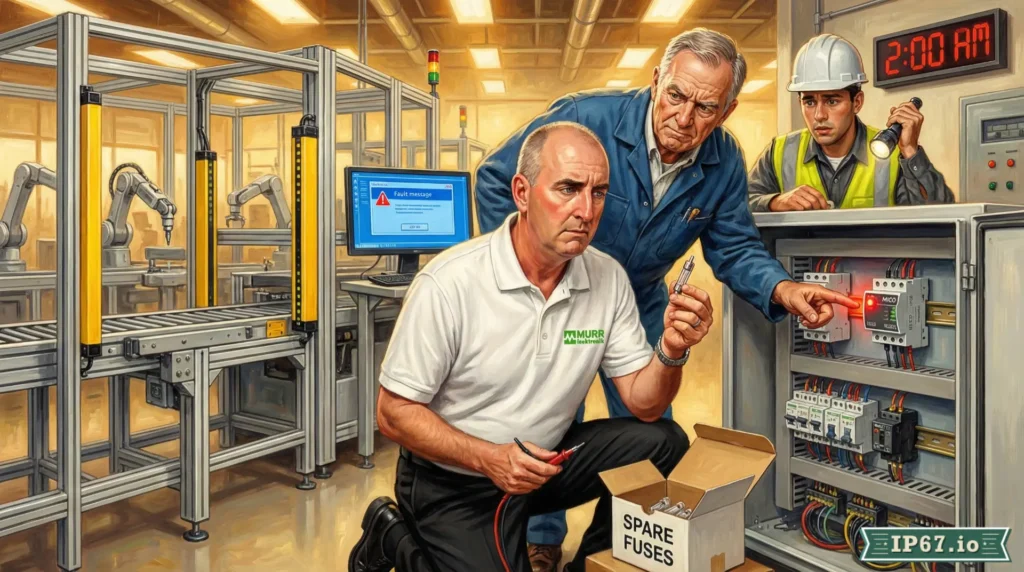
If you’ve ever stood next to a silent production line at 2 a.m. because a fuse blew, you know exactly where I’m going with this.
Your new machine has arrived. It looks great. Commissioning is complete. Everything’s working as it should — until one of the 24 VDC circuits trips.
Now, instead of a quick recovery, someone’s prying open a cabinet with a flashlight and a multimeter, trying to figure out which fuse popped. They check the door — where that little envelope of spare fuses is supposed to be. But it’s empty. Someone “borrowed” them last week for another machine and didn’t replace them. No one noticed until now.
Production stops. Maintenance gets called. Tension builds. All because the electrical system still relies on one-dollar fuses that no one thought to question during the specification phase. Now I hear some of you saying fuses cost cents, not dollars, not anymore. But even if they did, it’s just a few cents difference; the outcome is still the same.
Here’s the blunt truth: if you’re responsible for approving or specifying machine components, especially electrical control systems, you need to be pushing for smarter protection. Not later, now, at the design and specification stage. Because the minute that machine hits your floor, the cost of that “cheap” fuse becomes your cost. And believe me, it won’t just show up as a line item on a maintenance department P.O. — it’ll show up in downtime, lost production, missed targets, and 2 a.m. support calls you didn’t plan for.
Breakers Aren’t the Answer Either
Some will argue, “We don’t use fuses — we use circuit breakers.” But the hard truth is: you’re still stuck with an outdated compromise.
Yes, breakers are reusable and more familiar to many electricians. Some even come with optional remote reset features now. But let’s not kid ourselves — they’re still slow to react, they’re still limited in diagnostics, and most still require the panel to be opened for manual inspection and resetting.
Worse still, they often trip unnecessarily due to inrush currents — or worse, they fail to trip fast enough to prevent damage when it actually matters. They offer none of the preemptive warning, status feedback, or channel-level visibility that today’s production environments deserve. And if you’re already using breakers, the cost difference to upgrade to electronic protection is next to nothing.
So the real question becomes: why settle?
When a few extra dollars at the build stage can prevent tens of thousands in unplanned downtime, support calls, and lost production, it’s not an upgrade — it’s common sense.
To put it in perspective, recent research has shown that for an average manufacturing operation, an hour of unexpected downtime costs between $10,000 and $50,000 in lost production, idle labour, and missed deadlines. It’s even higher for other industries like automotive or oil and gas. A blown fuse doesn’t just stop a line. It starts a chain reaction that can get very expensive quickly.
Smarter Protection Starts at the Spec Stage
This is where electronic protection, like Murrelektronik’s MICO system, changes the game.
The MICO family of electronic circuit protection gives you real-time feedback, adjustable trip curves that handle inrush gracefully, 90% load warnings before faults happen, and a remote reset option – all in a compact DIN-rail footprint. You can instantly see which channel tripped. You can reset it from the HMI. You can recover in seconds – not hours.
That kind of speed and visibility doesn’t just make life easier – it boosts uptime, reduces troubleshooting, and improves OEE from day one.
We’ve come a long way from screw-in glass fuses and toggle breakers. MICO represents the third generation of protection – smart, proactive, and built for the realities of today’s manufacturing floor.
Spec What You Want to Live With
So if you’re specifying the electrical components on a new machine, take a hard look at the BOM. If you see rows of fuse holders or old-school breakers, pause and ask: Why aren’t we using electronic protection?
Because once that machine is commissioned and handed over, it’s your maintenance team, not the machine builder, who inherits the pain when things go wrong.
Don’t let cost-cutting during the build stage become a liability at the plant. Specify what you’d want if your bonus depended on the line staying up. (Because in many cases, it does.)
Change isn’t always easy. Maybe your team has been using fuses for 20 years. Maybe someone in your engineering department is pushing back on “unfamiliar tech.” But this isn’t about gadgets or gimmicks. It’s about building in reliability from the beginning, and eliminating failure modes we already know how to avoid.
Ask better questions. Don’t accept “we’ve always done it this way.” Because what you approve today becomes your problem tomorrow.
Machine Builders: Here’s How You Stand Out
And if you’re a machine builder reading this? This is your chance to raise the bar.
Fuses are cheap, sure. But they’re also the industry’s worst-kept shortcut. Everyone says they design for reliability and uptime. Want to prove it? Show your customer you spec smarter protection, not just the cheapest solution available.
Walk them through how electronic circuit protection like MICO improves recoverability, speeds up troubleshooting, and reduces support headaches long after the machine is installed. That conversation sets you apart from your competitors, helps you win more projects and keeps your customers coming back.
Ready to Specify Smarter?
If you’re still specifying fuses or relying on basic breakers, let’s talk. I review machine specs every week for teams who want to reduce downtime, improve OEE, and stop wiring in problems we already know how to solve. I’ll show you where smarter protection like MICO fits — and how a small change in your BOM can make a massive impact on the floor.