If you have spent some time around industrial machines, you already know the story. The machine looks well-built, quality parts have been used, the panel is tidy, and yet something electrical keeps going wrong.
An input drops out for no obvious reason. A sensor faults once a shift and then behaves perfectly for the rest of the day. A servo axis refuses to home until someone opens the cabinet, accidentally touches a wire, and suddenly everything is fine again. After a while, electrical teams start treating this as normal, like it comes with the job.
But here’s the key point: most of these problems are not caused by “bad parts.” They’re caused by how the machine wiring is connected.
And not all connection points are the same.
The Types of Electrical Failures Everyone Recognizes
You don’t need to be an expert to see wiring problems. You see them all the time, especially on machines that run hard every day in high-production environments.
Intermittent faults are the classic. The machine runs fine for hours or days, then an input drops a signal or faults a module, and then the fault just disappears. When someone finally shows up to troubleshoot, everything is normal again.
Random electrical faults are common on traditionally wired machines. An I/O device stops working even though it has power, and nothing in the program has changed. Someone cycles power or tugs a few wires in the panel, and it starts working again, at least for a while.
Then there are the “magic fixes.” A sensor works again as soon as someone touches the cable or moves a wire in the wire duct. No part changes. No setting changes. Just a tiny movement and the machine behaves.
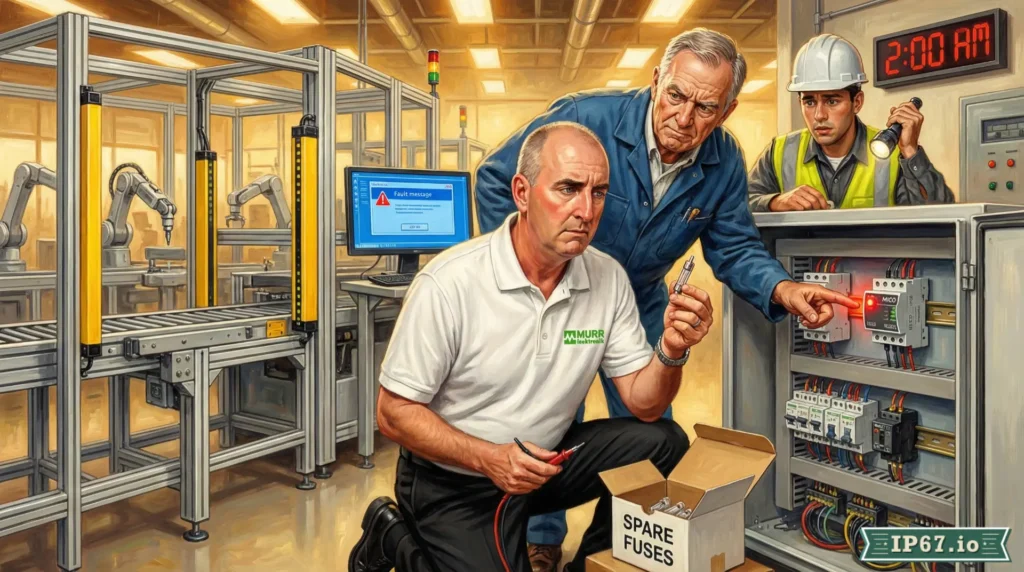
And of course, that fault that only shows up at 2 a.m. Everything works fine while the cabinet is open, and electricians are watching. The problem returns as soon as they walk away.
Why Components Are Rarely the Root Cause
Modern industrial parts are usually very reliable. PLCs, I/O modules, sensors, power supplies, and drives are built and tested to handle tough conditions. These days, the MTBF on most components is years, if not decades.
When a part does fail, it usually fails very clearly. It stops working. It faults the same way every time. It does not “fix itself” because someone touched a wire or closed a cabinet door.
So when an electrical problem comes and goes, it’s often not the part that’s the real issue. It’s a connection point.
The Big Difference: Human Connections vs Factory Connections
Most machines still rely on many human-made connections. That means a person strips wires, crimps ends, tightens screws, and hopes every connection is perfect. These connection points include terminal blocks, hand-wired junction boxes, field-wirable connectors, IP20 I/O modules, and any repair where wires are re-terminated or crimped together.
Manual connections like these work, but they are not consistent. No two people will connect wires to terminals the same way. Some may be more careful, but people get rushed, tools vary, and labels sometimes fall off. Over time, vibration and movement can loosen things. Even good technicians can’t remove all the variation when there are hundreds or thousands of these connection points.
Factory-made connections are different. With IP67 connectorized systems, the cable and connector are made in a controlled process, sealed with over-molded housings, and typically tested before they leave the factory. These factory connectors are much more repeatable and not dependent on who installed them or how tired they were that day.
This is why IP67-rated connectors are not just about being waterproof. They’re about fast, consistent connections that behave the same way, every time, across every machine.
Why Human Connections Create “Random” Faults
Wiring gets pulled during installation. It gets moved during commissioning. It gets tugged during troubleshooting. Machines also get modified over the years, and each change increases the likelihood that wiring is not properly documented.
Human-made connections take the hit first. A screw terminal that was “fine” can become slightly loose. A conductor can get nicked. A crimp can be just a bit off. None of these show up as an obvious failure at first, so you get the worst kind of problem: the intermittent faults that come and go when they feel like it.
That’s why touching a wire in a cable tray can “fix” it. You’re not fixing the actual problem. You’re temporarily improving a bad connection.
The Takeaway
Most electrical problems are not random and are not usually related to component quality. They are often the predictable result of machines that have many human-made wiring termination points.
If you want fewer electrical failures and easier troubleshooting, eliminate as many human-made connection points as you can. Electrical reliability starts early. It starts with design decisions that reduce terminations and replace variable human-made points with repeatable, sealed, factory-made connection points.
That is why connectorized IP67 architectures tend to feel so boring in the best way. When the wiring is designed as a system rather than a craft project, the machine behaves the same way.
And machines with factory-made, IP67 connectorized cables are the most reliable.