A couple of weeks ago, I had an interesting conversation with a controls manager at a large machine builder. He was clearly frustrated. Despite his best efforts, the company still wasn’t seriously looking at total cost of ownership when it came to their control systems. Instead, they continued to specify centralized designs, full of cabinet wiring and terminal blocks, while ignoring the proven savings of decentralized IP67 solutions.
He wasn’t talking about skilled labour shortages. He wasn’t complaining about customer specs that were out of date. He was venting because he could see the waste at his company. His team was spending hours wiring up systems that didn’t need to be as complex as they were, landing and marking every wire then still chasing faults on startup. He was frustrated because he knew there was an easier, more efficient way to wire machines, but no one was serious about changing anything. All the decisions at his company were being made in silos.
Not a Technical Problem – A Cultural One
That’s what struck me most. It wasn’t a technical issue. It was cultural.
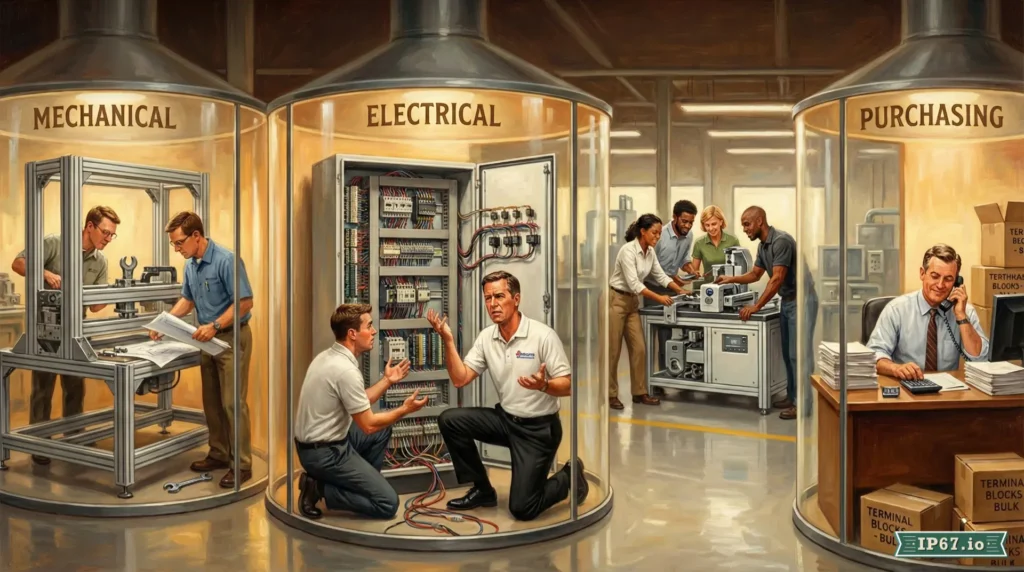
The mechanical team worked one way. The electrical team worked another. Purchasing had their own priorities. Sales didn’t want to disrupt the quoting process. Assembly just built what was handed to them. And commissioning? They were stuck at the end, trying to make it all work, often under pressure and without context. Everyone was doing their job. But no one was stepping up to hear about a better way to build their machines.
The Terminal Block: Familiar, But Costly
And that brings me to one of the most deceptively expensive components in the entire control architecture: the terminal block.
On paper, it’s harmless. Cheap, proven, and readily available. It’s been a staple in control panels for decades, and for good reason. But in most machine builders, its continued use is more about habit than necessity. It’s what the CAD templates are built around. It’s what purchasing can negotiate on. It’s what the panel shop knows how to install. It’s what the customer expects to see when they open the panel.
No one questions it – and that’s the problem.
Because the moment you zoom out and look beyond the component price, the real cost of that terminal block starts to come into focus. Not just in dollars, but in time, risk, labour, and the friction it creates from design through to commissioning and service. And the only reason that cost isn’t more visible? The people feeling the pain are rarely the ones making the main decisions.
A Hidden Cost Passed Down the Line
The salesperson, focused on winning the job, includes terminal blocks in the proposal because that’s what the customer has always received. The electrical designer includes them in the drawing package because they’re safe, familiar, and the way they’ve always done it. Purchasing finds a supplier who can offer a better price (maybe a few cents saved per block) and then marks it down as a win. The panel shop gets to work installing the blocks, stripping wires, landing them, and labelling one wire at a time. Then checking it all twice to make sure it matches the drawings. And then, after all of that, the startup and commissioning teams still get electrical errors. Maybe a few signals aren’t coming through. Maybe a valve doesn’t fire. Maybe another device doesn’t power up. More often than not, the issue is traced back to a simple wiring error on a terminal block or field wireable. A conductor landed in the wrong place. A screw that wasn’t quite tight enough. A label that fell off.
None of this is surprising. It’s just what happens when you build machines the way they’ve always been built – with a focus on part cost and departmental efficiency, rather than total installed cost and teamwide alignment.
A Better Way, Built In
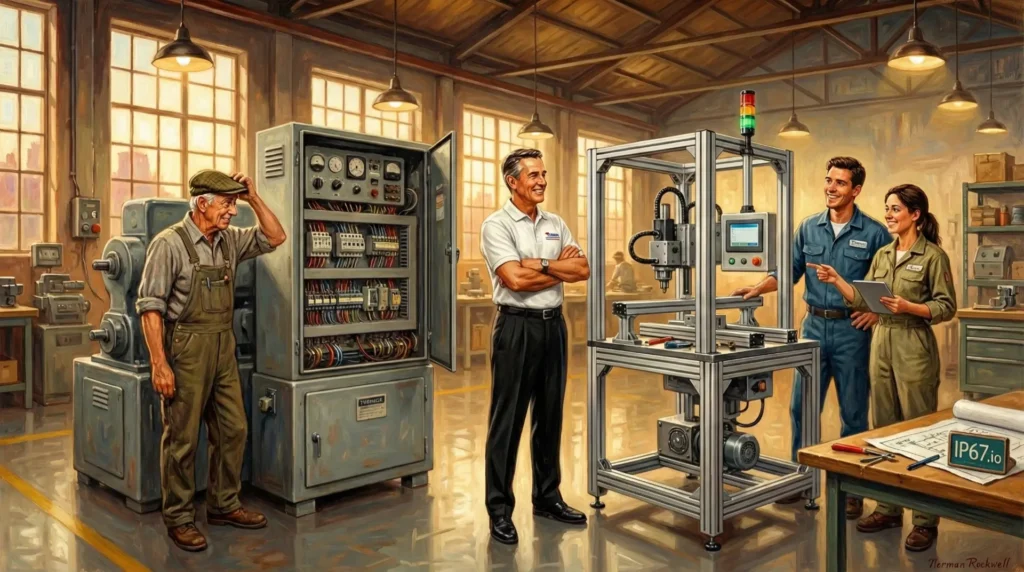
Now imagine the same machine built around a decentralized IP67 architecture. Instead of bringing every I/O point back to a cabinet, your design team places rugged modules directly on the machine. Each device plugs in with a pre-moulded connector. There’s no stripping. No ferrules or screw terminals. Just clean, fast, and reliable connections. Every time.
The electrical drawings become simpler. The whole machine build moves faster. Commissioning happens with fewer headaches. There’s less room for error, and less need for rework. Maintenance teams, six months down the line, can diagnose issues without tracing a rat’s nest of wires through a crowded cabinet. And yes, the component cost is higher, but the real savings come from the time, the labour, and the stress that never happens in the first place.
It’s not a hard case to make once you look at it honestly. But in a siloed company, that conversation rarely happens. And even when it does, the people making the argument are often not the ones with the authority to act on it. That’s why the terminal block keeps showing up. Not because it’s the best solution, but because nobody is paid to challenge it.
Leadership Is the Missing Link
The good news is that this isn’t hard to fix. But it does require leadership.
If you’re a CEO, VP, or executive leader at a machine builder, this is where your role becomes critical. It’s your job to break down and connect the silos. To invite the people closest to the work – the installers, the electricians, the techs on the floor – into the conversation early. To reward those who challenge the status quo with better ideas. To stop measuring departments in isolation and start aligning teams around total outcome.
Ask your sales team what they’re including by default that might not make sense anymore. Ask engineering where they’re still playing it safe because it’s easier. Ask purchasing if they’ve ever been briefed on labour costs and the Total Cost of Ownership. Ask your field techs where they see problems most often. Then bring those people together. Get them talking about how to eliminate friction, not just hit their individual KPIs.
The Companies That Win, Build Differently
The smartest machine builders I know aren’t necessarily the ones with the newest technology. They’re the ones who create the conditions for their teams to speak up, share what they see, and act on it. They’ve built a culture where someone in panel assembly can say, “Why don’t we switch to a pre-wired solution?” without worrying about their job.
You don’t need to reinvent your business. But you do need to start rewarding the people who want to make it better. Because those are the people who will show you where the real savings are hiding.
It might be in the drawings. It might be in the wiring. It might be in a terminal block that nobody’s ever thought to remove.
But it won’t show up on a quote sheet. And it won’t be visible in a single department’s numbers.
You’ll only see it when you step back, break the silos, and start looking at the full picture.