
Think about it.
You expect the cable that charges your phone to be molded, sealed, and factory-tested. You certainly wouldn’t expect to get a single ended cable and field connector in the box for you to assemble yourself. And you definitely wouldn’t expect to build your own USB cable every time you bought a new printer.
So why are you still accepting that level of DIY when it comes to industrial connections on your six-figure machines?
If you’ve been following my Stop Specifying Downtime series, you know I’ve been on a bit of a mission lately. A mission to help factory engineers, designers, and project managers make smarter, more forward-thinking decisions. Decisions that don’t just meet the spec but actually reduce the likelihood of future downtime.
We’ve talked about the limitations of terminal blocks. We’ve looked at the problems with using fuses in modern machines. Today, we’re focusing on something that seems small but quietly causes more than its fair share of trouble on the plant floor: the way devices are connected on your machines.
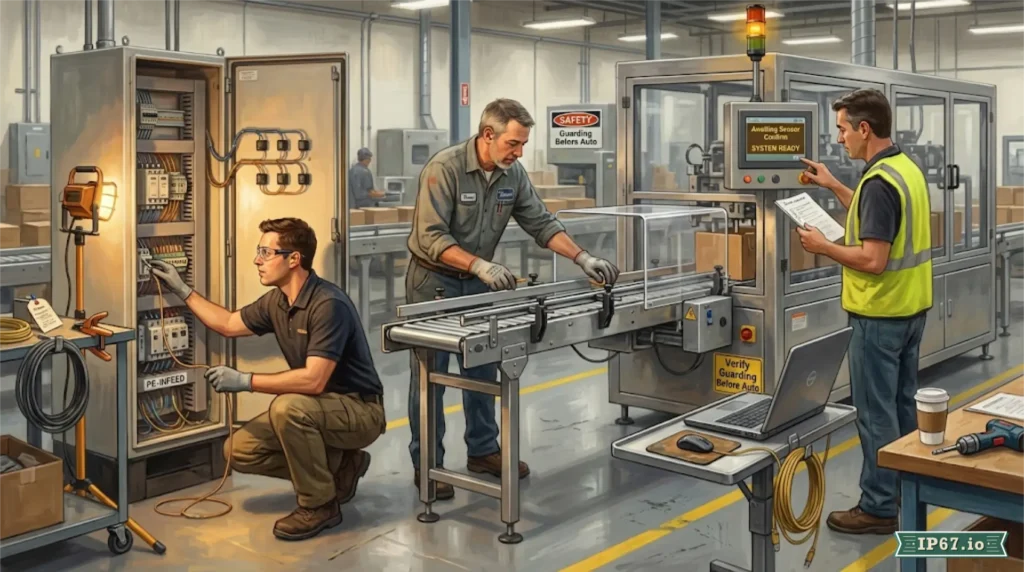
Specifically, I’m talking about hand-wired connection points. Terminal blocks, screw-clamp connections, and field-attachable connectors. These options might look cost-effective on paper. They might feel like the flexible choice. But once those machines are in the field and exposed to vibration, moisture, and real-world wear, those decisions often become the root cause of hard-to-find intermittent faults and unplanned downtime.
If you’re still allowing your machine builders or OEMs to use these types of connections without questioning whether they belong in the design, now is the time to stop and take a second look.
Let’s walk through what’s really happening, and what you can do about it.
Why Screws and Vibration Don’t Mix
Here’s the scene I still see far too often. I’m standing in front of a brand-new machine, one that just rolled out of a modern machine builder’s shop, and I see a junction box with screw terminals inside, staring back at me like it’s 1968.
Now don’t get me wrong. Terminal blocks serve a purpose. But the issue isn’t whether they work at all. It’s how they hold up in the real world. Screws loosen. Vibration doesn’t care about your torque specs. Thermal cycling will slowly pull connections apart. And even the most meticulous assembly process is still relying on human hands, which means every single connection carries some degree of inconsistency.
Spring terminals help. So do torque screwdrivers and lock washers. But none of that changes the core truth. When you’re depending on a mechanical connection made in the field, by hand, you’re building in a potential failure point that will come back to bite you in the future.
The Illusion of Sealing with Field-Wired Connectors
And it’s not just terminal blocks. Field-assembled circular connectors also get a pass far too often. On paper, they look great. IP67 rated. Modular. Custom cable lengths. What’s not to love?
Well, plenty, once you start seeing how they behave outside of the brochure.
You see, that IP67 rating? It’s only real if the connector is assembled correctly. That means the cable jacket is stripped to the right length. The gland isn’t overtightened. The conductors are trimmed to the right length. And the installer doesn’t cut through too many wire strands during the process.
That’s a lot of steps to get right. And unfortunately, in the real world, they don’t always get followed to the letter. I’ve seen field connectors installed with missing cable glands, wires exposed, over-stripped terminations, and connector housings that were not tightened down all the way. The worst part is, you usually don’t discover any of this until something goes wrong. A sensor starts dropping out. Moisture gets in. Intermittent faults crop up. And the whole maintenance team starts chasing ghosts.
Eventually, the problem gets traced back to the connector. Or more accurately, the person who assembled it.
The Case for Overmolded Connectors
Now compare that to a factory-molded connector. These assemblies are terminated, sealed, and strain-relieved under controlled conditions, then electrically tested before they ever get installed on a machine. When you plug them in, you know what you’re getting. The seal is there. The contact is consistent. The strain relief is baked into the overmold. There’s no wires to over-strip and no cable gland to misplace.
And here’s the key part. Once they’re in, they stay in. There’s nothing inside that can loosen. Nothing to creep. Nothing that becomes loose after six months of vibration.
In effect, you’ve removed one of the most common human error points from your machine’s electrical system. That decision, made early in the specification process, can save your maintenance team hours of troubleshooting and thousands of dollars in unplanned downtime.
What the Field Has Already Proven
This isn’t just theory. I’ve spoken to controls engineers, integrators, and machine builders who’ve made the switch from hand-assembled field connectors to double-ended overmolded cordsets and never looked back.
One example I still remember from a couple of years ago came from a Tier 2 automotive plant. They’d been dealing with intermittent sensor signals on one of their machines. Dozens of dropped signals over just a few months. All of them were traced back to field attachable connectors and poor assembly. They eventually replaced all the sensor cables on that machine with factory-made double ended cables and re-specified over-molded connectors on both ends for all sensor cables on new machines.
Two years later, not a single connector failure to the best of my knowledge
And that’s the point. This isn’t just about improving reliability. It’s about eliminating a class of failures entirely.
The Downtime Math Doesn’t Lie
Now let’s talk about the money.
Sensor cables with overmolded connectors on both ends might look more expensive at first glance compared to a single-ended cable paired with a field-attachable connector. But that cost difference disappears fast once you factor in the labour to install the field connector properly. And let’s be honest—somewhere between 5 to 7 percent of those field-assembled connectors will need troubleshooting or rework anyway.
When you add it all up, those pre-made double-ended cables often end up costing less overall. And that’s before you even consider the cost of downtime.
If a machine goes down for just 45 minutes because of a bad connection, and that line is generating $10,000 an hour, you’re looking at $7,500 in lost production.
All because someone thought they were saving a few bucks on a connector.
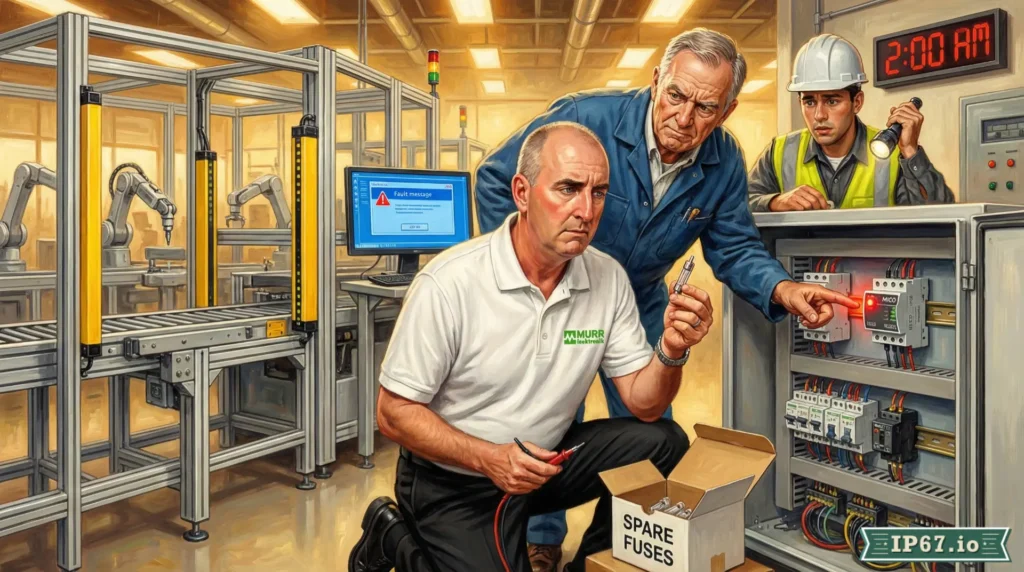
So the next time someone says it’s too expensive to specify double-ended cables with factory overmolded connectors, ask them this: how expensive is it when your maintenance tech is crawling under a machine with a multimeter and a flashlight, trying to troubleshoot a field-assembled connector? Especially when you’ve already lost two hours of production because of a loose screw or over-stripped wire.
So What Should You Be Specifying?
If you’re responsible for machine specifications, electrical standards, or procurement approvals, this is where you can make a real difference.
Use factory installed overmolded connectors for cables connected to devices that are exposed to moisture, vibration, or temperature variations. Don’t leave critical terminations up to field assembly. Specify known, 100% tested cordsets from reputable suppliers. Design with modularity in mind so that a damaged cable can be swapped out in minutes rather than rewired during an hour-long shutdown.
And maybe most importantly, take field-assembled connectors off your approved part list unless there’s a genuinely good reason to use them.
When you do this, you’re not just preventing future connectivity failures. You’re specifying cables on a machine that’s now easier to build, quicker to commission, and far less likely to throw intermittent signal faults at your production team later on.
Why This Still Happens
So why are we still seeing hand-wired terminals and field-made connectors on modern machines?
It usually comes down to three things. Machine builders who don’t calculate cable lengths during design, machine builders who are resistant to change, and machine builders who do not want to keep multiple lengths of cable in stock.
The truth is, we’ve reached a point in industrial automation where the expectations have changed. Machines are expected to run longer, with fewer breakdowns, and often with less experienced people maintaining them.
The wiring practices we used twenty years ago just don’t cut it anymore. And the good news is, we don’t need to keep using them. We’ve got better tools now. We just need to use them.
Wrapping Up
You can have the best PLC on the market. The most advanced I/O modules. The toughest sensors you can buy.
But if the connection points between them are hand-terminated and inconsistently assembled, you’ve just built in a future downtime risk that didn’t need to be there.
Wiring isn’t just wiring. It’s your machine’s nervous system. And it deserves just as much attention as the logic running behind it.
If you’re ready to look at your current machine specs or want a second opinion on how to reduce failure points in your field wiring, feel free to reach out. I offer a complimentary control system assessment for project teams who want to get ahead of future connectivity faults.
Let’s stop specifying downtime, one connection at a time.