The workforce is changing. Are your machines?
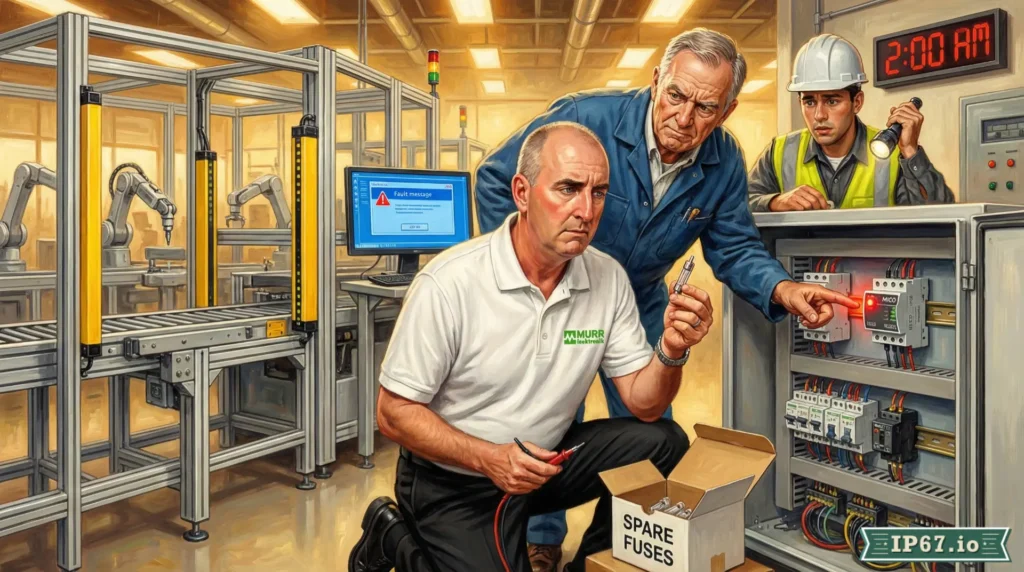
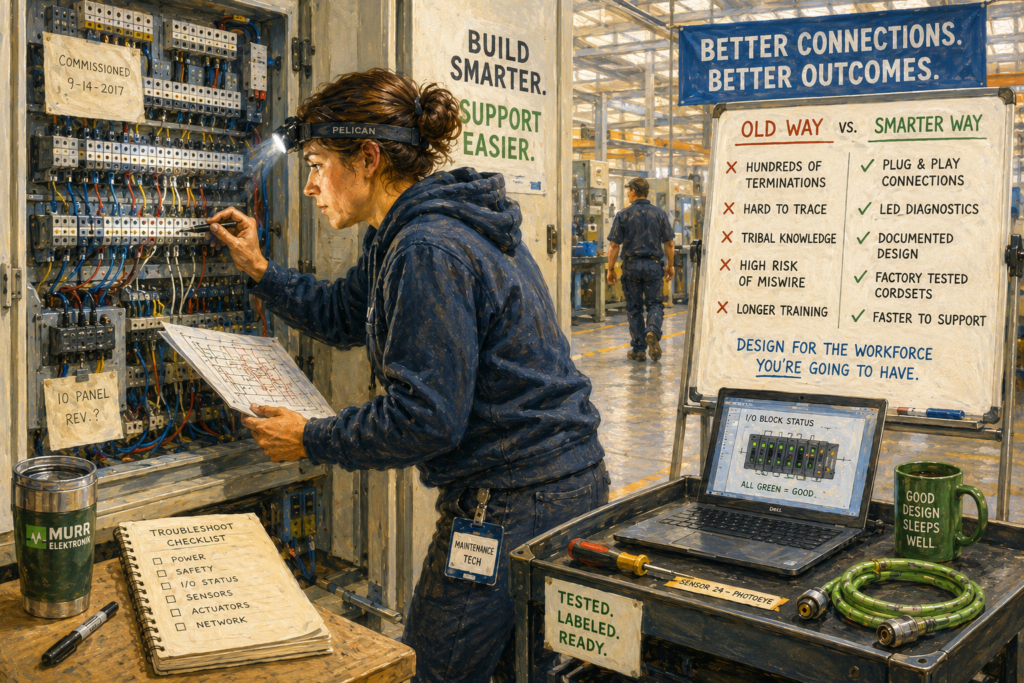
Picture a maintenance tech at 2 a.m., headlamp on, standing in front of a DIN rail full of terminals that hasn’t been touched since commissioning. Nothing on the panel tells her which of the forty terminal blocks is actually feeding the sensor throwing the fault. She’s tracing wire by wire, hoping the schematic in her hand still matches what’s actually in the cabinet. That’s a real Tuesday night on a lot of production floors right now, and it’s the moment where the skills gap in our industry stops being a slide in an HR presentation and starts costing real money.
Every generation gets accused of not wanting to work the way the one before it did. In manufacturing, the current version goes something like this: Gen Z doesn’t have the patience for complex wiring work, they want everything plug-and-play, they expect the technology to do too much of the thinking. Maybe. But that conversation is a distraction from the question that actually matters for anyone running a machine-building business. Can your production model survive in a labour market where the experienced panel builders, electricians, and controls people are retiring faster than you can replace them?
The traditional approach to machine wiring was built around a workforce that spent years learning schematics, terminal strips, ferrule systems, and the tribal knowledge that never made it into any document. Those people knew the panel by feel: which wire duct always got congested, which field device was likely to get miswired, what a fault sounded like over the phone before they’d even opened the cabinet. That expertise is real, and it’s valuable. The problem is your build schedule and your service commitments can’t keep depending on it being available whenever you need it, because it’s walking out the door.
Nearly a third of the U.S. manufacturing workforce is already over 55. For every five skilled tradespeople who retire, roughly two are coming in behind them, and that five-to-two ratio gets worse every year it goes unaddressed. The exposure gets sharper at the supervisor level: 70% of electrical supervisors are Baby Boomers. When that layer retires, it doesn’t just take a job title with it. It takes the mentorship and the institutional memory that trained the next tier, all at once.
The U.S. Department of Education and JLL project that 2.1 million skilled trades jobs will go unfilled by 2030, with annual economic losses reaching $1 trillion. Plenty of machine builders are still budgeting for experienced electrical labour on the same timeline and at the same cost as a decade ago. That plan carries more risk than the P&L is showing.
Gen Z didn’t grow up stripping wire. They grew up plugging things in. Every device in their world was built to connect fast, give immediate feedback, and make a failure obvious the moment it happened. When something breaks, their instinct is to check the connection, look for an indicator light, swap the cable, or read the diagnostic message. On a modern machine, that instinct is exactly what you want from the tech at 2 a.m.
Gen Z grew up plugging things in
Most wiring architectures still don’t give them that. We hand a new hire hundreds of individual conductors and ask them to strip, crimp, label, land, and torque every one, then wonder why the learning curve is brutal, and the work feels foreign to how they’ve interacted with technology their whole lives. It’s a mismatch, but it’s not a capability problem. We’re asking a plug-and-play generation to work inside a system built for an apprenticeship model from a labour market that no longer exists at scale.
The training economics nobody wants to say out loud
Reading a schematic is one skill. Building a real panel under schedule pressure, with rework and supervision folded in, is another, and it takes months of repetition before someone is truly independent on it. Meanwhile, Randstad’s 2025 workforce report, drawn from 126 million job postings, puts the average early-career tenure at 1.1 years for Gen Z, versus 1.8 years for Millennials, 2.8 years for Gen X, and 2.9 years for Baby Boomers.
A wiring process that takes months before someone becomes productive runs straight into a workforce that stays in the role for months, not years, and that math doesn’t work in your favour. You invest the training time, the person finally gets good at it, and then they move on. Designing the work so people can contribute sooner means matching the build process to the workforce you actually have, not the one you wish you still had.
The skilled electrician still matters, and the experienced panel builder matters more than ever, because you need them doing the work only they can do. The point is to stop burning their time on repetitive termination work that a better design could have removed from the process entirely.
Knowledge that only lives in people is a liability
In most machine-building shops, the knowledge required to build, commission, and troubleshoot a machine doesn’t live in the system. It lives in the panel builder who knows the machine family by memory, the electrician who knows which drawing revision was always a little off, the controls person who can hear three words about a fault and know exactly where to look. By rough industry estimate, something like three-quarters of that knowledge is sitting in people’s heads on a traditional build, with only a quarter of it actually documented or designed into the system. That ratio is fragile. The day that person retires, changes roles, or is just out sick when the machine has to ship, the business feels it immediately.
This is where connectorized and modular architecture stops being a cleaner way to build a panel and becomes a real risk-management decision. A keyed M12 connector cuts down the number of ways a connection can go wrong. A labelled cordset lets someone identify a connection without cracking open the schematic. An IP67 I/O block with per-channel LEDs gives a technician a visual answer instead of a guessing game. A factory-tested cordset removes a hand-made termination from the build entirely, along with every failure mode that came with it.
Moving to this kind of architecture changes where the risk sits. Miswiring gets caught at the factory before the machine ever ships, because keyed connectors and pre-tested cordsets are doing that work instead of a field electrician. Diagnosing a fault stops depending on one senior tech’s memory, since an LED on the block gives the same answer to whoever’s on shift. Because the design is the same everywhere, machine fifty looks like machine one instead of whoever happened to be running the panel that week. New hires get productive faster because they’re identifying and verifying connections rather than memorizing schematics, and a customer’s maintenance tech can swap a cable in minutes instead of tracing a terminal strip at 2 a.m.
This is an executive call, not just an engineering one
Someone will read all this and hear “lower the standard.” Good engineering does the opposite. It removes complexity that isn’t earning its keep, and it still demands solid design, real documentation, and validation before anything ships. Some tasks require real skill because the application genuinely calls for it. Train your people well on those, and protect the standard. Other tasks only require skill because the design forces someone through hundreds of manual, variable, repetitive operations. That kind of task deserves a second look, and probably a redesign.
There’s no advantage in making a simple connection complicated, and no value to your customer in burying knowledge in undocumented wiring habits that only one person understands. Handing the next generation of workers a wiring problem you already have the tools to design away is just an unforced error, not a tradition worth defending.
Every senior leader at a machine builder has this decision sitting in front of them right now. You can keep asking new workers to adapt to wiring methods built for a workforce that’s actively retiring out of the trade, or you can start designing machines around the workforce you’re actually going to be hiring for the next ten years. Those two choices lead to very different places. The builders who get this right won’t just ship cleaner machines. They’ll ship machines that scale without drama, that a service tech can actually support, and that the next generation can walk up to and understand without needing a decade of scars first.
Gen Z doesn’t want to wire machines the old way. Good. They might be telling us something the rest of us should have acted on years ago.
Want the longer version of this argument, including the labour data, the tribal knowledge risk, and the build economics in more detail? We put it all into a white paper: How to Get Gen Z to Wire Machines. It’s a free download, no form to fill out.